GAD-7 score: what your 0 to 21 total means
A GAD-7 score is a total from 0 to 21, and it falls into one of four bands: minimal, mild, moderate or severe. The cut points sit at 5, 10 and 15, and a total of 10 or more is the point where the result is worth taking to a doctor.1
Download on the App StoreNo account required. Start with a free anxiety check-in.
Where the number comes from
The GAD-7 is seven questions about the last two weeks, each asking how often a problem has bothered you. An answer scores 0 for not at all, 1 for several days, 2 for more than half the days and 3 for nearly every day. Your total is those seven numbers added together.1,2
The seven problems are feeling nervous, anxious or on edge; not being able to stop or control worrying; worrying too much about different things; trouble relaxing; being so restless that it is hard to sit still; becoming easily annoyed or irritable; and feeling afraid as if something awful might happen.2
Seven questions at 3 points each is why 21 is the ceiling. If the total on your form looks off, re-add the seven numbers. Changing one answer from "more than half the days" to "nearly every day" adds a point to the total, and near a cut point that is enough to change the band.1
The four GAD-7 score bands
| Total | Band | What it means |
|---|---|---|
| 0 to 4 | Minimal | Few or no symptoms over the last two weeks |
| 5 to 9 | Mild | Mild symptoms, below the referral cut-off |
| 10 to 14 | Moderate | Further evaluation is recommended |
| 15 to 21 | Severe | Active treatment is probably warranted |
In the study that introduced the questionnaire, higher scores went with more impairment on every measure of day-to-day functioning it used, including days of disability, so a higher band generally means anxiety is affecting ordinary life more.3
What a score of 10 or more means
A total of 10 or more is the recommended cut point for further evaluation when the GAD-7 is used to screen for anxiety disorders. That score is a yellow flag, and a score of 15 or more is a red flag.1
Further evaluation means talking to a health care provider, such as a primary care doctor, a psychiatrist, a psychologist or a clinical social worker. Take the number with you, along with the date you answered, because the score describes two specific weeks and the provider will want to know which ones.4
With a moderate total, 10 to 14, that conversation is the next step. The clinician decides from there whether the anxiety needs treatment. A severe total, 15 to 21, is more urgent, and treatment should come up in that conversation.1
Does the score mean you have an anxiety disorder?
No. The GAD-7 is a screening questionnaire, and a screening score is a reason to be assessed rather than a diagnosis. In the validation study, the chosen cut point picked up 89% of people who had generalized anxiety disorder and correctly cleared 82% of those who did not. Some people above the cut point do not have the disorder, and some below it do.3
A diagnosis also rests on things a two-week questionnaire cannot see. For generalized anxiety disorder, a person must find it difficult to control worry on most days for at least six months, and establishing that is a clinician's job. Symptoms also fluctuate and are often worse during stress, such as a physical illness, exams or a family conflict, so one total can be high for reasons that pass.4
The GAD-7 is not specific to generalized anxiety either. It also performs moderately well at picking up panic disorder, social anxiety disorder and post-traumatic stress disorder, so a high total shows anxiety is present without identifying which disorder it is.1
Retaking the GAD-7 and comparing scores
Because every question covers the last two weeks, a retake two weeks later measures a fresh period and gives you a total you can compare with the first. Compare the totals and their bands rather than single answers.1,2
If the retake comes out a point or two from your earlier total and stays in the same band, it is telling you the same thing. The result to pay attention to is a total that lands in a different band, especially one that crosses 10, since that is the cut point for further evaluation.1
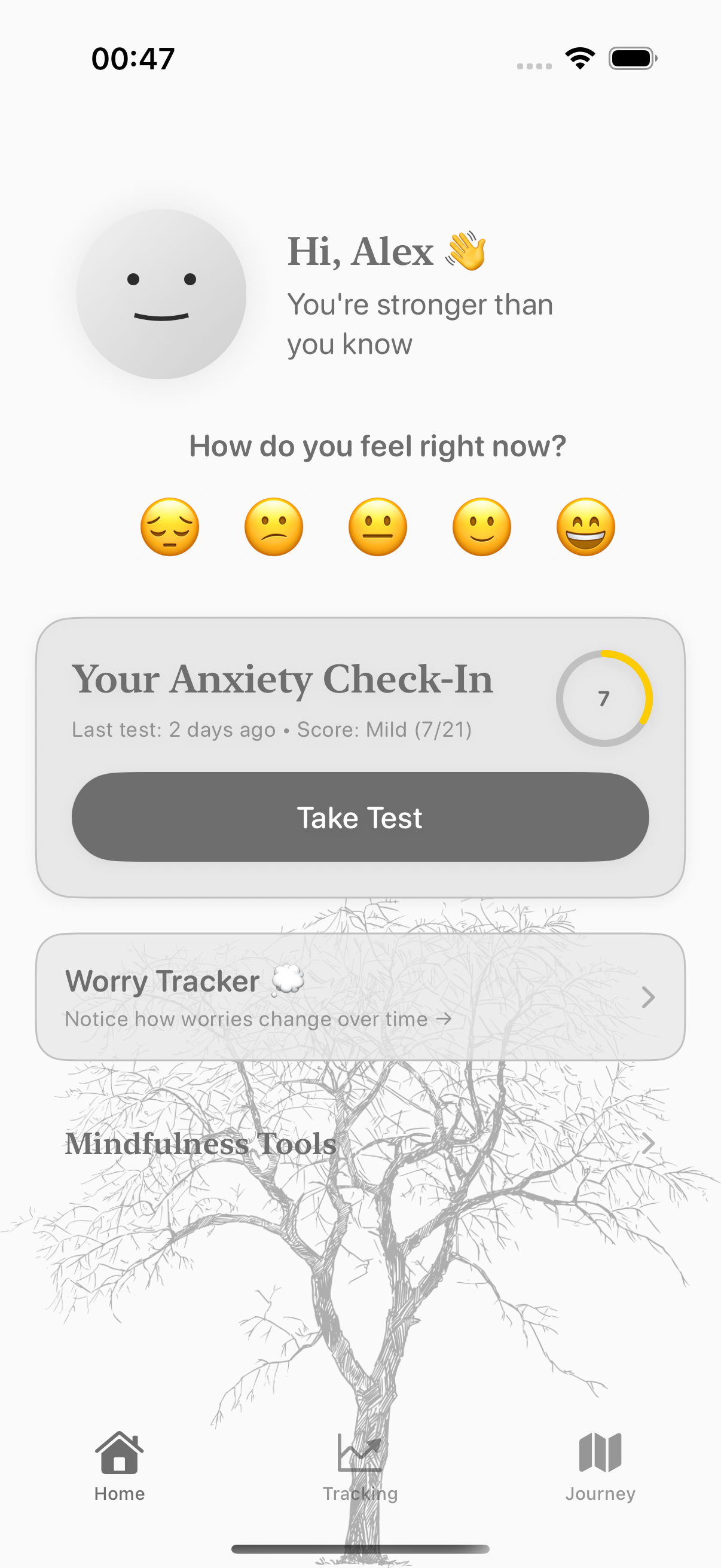
If you take the check-in in Balmi: Anxiety Tracker & Test, you answer those same seven questions and finish with your total and its band. Every result is saved, Home shows the latest score and band, and a weekly reminder can prompt the next one.
Balmi's Tracking tab gathers every check-in into a chart of scores over time and a calendar that marks the days you checked in. Check-ins need no account and are kept on your device.
Get a clearer picture of how you feel.
Download on the App StoreNo account required. Start with a free anxiety check-in.
Sources
- 1.phqscreeners.com, “Instruction Manual: Instructions for Patient Health Questionnaire (PHQ) and GAD-7 Measures,” phqscreeners.com
- 2.phqscreeners.com, “GAD-7 (the questionnaire, English),” phqscreeners.com
- 3.PubMed, U.S. National Library of Medicine, “A brief measure for assessing generalized anxiety disorder: the GAD-7,” pubmed.ncbi.nlm.nih.gov
- 4.National Institute of Mental Health, “Generalized Anxiety Disorder: What You Need to Know,” nimh.nih.gov