GAD-7 scoring: how to add up your answers and read the total
GAD-7 scoring is simple arithmetic: each of the seven answers is worth 0 to 3 points, and adding them gives a total from 0 to 21. The total falls into one of four bands, minimal, mild, moderate or severe, and a total of 10 or more is the usual cutoff for a closer look.1
Download on the App StoreNo account required. Start with a free anxiety check-in.
Turn each marked answer into points
Every line of the GAD-7 offers the same four answers for how often a problem bothered you over the last two weeks, and each answer has a fixed value: not at all is 0, several days is 1, more than half the days is 2, and nearly every day is 3. The seven values are then added, and the sum is the score.1,2
Scoring a GAD-7 by hand
- 1.
Write the points next to each of the seven answers
Read down the sheet and mark 0, 1, 2 or 3 beside the box ticked on each line.1
- 2.
Skip the difficulty question
The question under the seven items asks how difficult these problems have made it to work, take care of things at home or get along with other people. It is never added to the total; it records how much the symptoms get in the way, which is a different thing from how often they happen.1
- 3.
- 4.
Look up the band
Totals of 5, 10 and 15 are the cutpoints, so 0 to 4 is minimal, 5 to 9 mild, 10 to 14 moderate and 15 to 21 severe. The table further down is where you check your own total.1
A worked example
Here is one example sheet scored line by line, so you can check your own math against it.
| Question | Answer marked | Points |
|---|---|---|
| Question 1: Feeling nervous, anxious or on edge | More than half the days | 2 |
| Question 2: Not being able to stop or control worrying | More than half the days | 2 |
| Question 3: Worrying too much about different things | Nearly every day | 3 |
| Question 4: Trouble relaxing | Several days | 1 |
| Question 5: Being so restless that it is hard to sit still | Not at all | 0 |
| Question 6: Becoming easily annoyed or irritable | Several days | 1 |
| Question 7: Feeling afraid as if something awful might happen | More than half the days | 2 |
Add the points column: 2 + 2 + 3 + 1 + 0 + 1 + 2 = 11. A total of 11 sits in the moderate band and is just over the cutoff of 10.1
Two slips are worth checking for. A difficulty answer counted into the total pushes it up by as much as 3, and a column read as 1 to 4 instead of 0 to 3 adds 7 to every score.1
Read your total: the four GAD-7 bands

| Total score | Band | Cutoff of 10 |
|---|---|---|
| 0 to 4 | Minimal | Under 10 |
| 5 to 9 | Mild | Under 10 |
| 10 to 14 | Moderate | 10 or above |
| 15 to 21 | Severe | 10 or above |
A score of 6 is mild. The problems showed up on some days over the two weeks, and the total stays under the cutoff that calls for further evaluation.1
A score of 14 is high: it is one point below severe. In the original study, higher totals went with more impairment in daily functioning across every domain measured.1,3
The total describes the last two weeks only. Anxiety symptoms rise and fall over time and are often worse during times of stress, such as an illness, exams or a family conflict, so the same person can score in different bands a month apart. Score the sheet again later if you want to see whether the total has changed.2,4
What a total of 10 or more means
A total of 10 or greater is the recommended cutpoint for further evaluation. That total is a yellow flag, a sign that the symptoms may be clinically significant. A total of 15 or greater is the red flag, where active treatment is probably needed.1
The cutoff comes from the study that introduced the scale. It ran in 15 primary care clinics in the United States, 2740 adults filled in the questionnaire, and 965 of them were interviewed by a mental health professional within a week. The cutoff of 10 picked out 89 percent of the people the interview found to have generalized anxiety disorder and correctly cleared 82 percent of the people who did not have it.3
GAD-7 scoring in the Balmi app
On your iPhone or iPad, Balmi asks the same seven GAD-7 questions about the last two weeks and does the adding for you. The check-in ends with a screening score from 0 to 21 and the band it falls in.
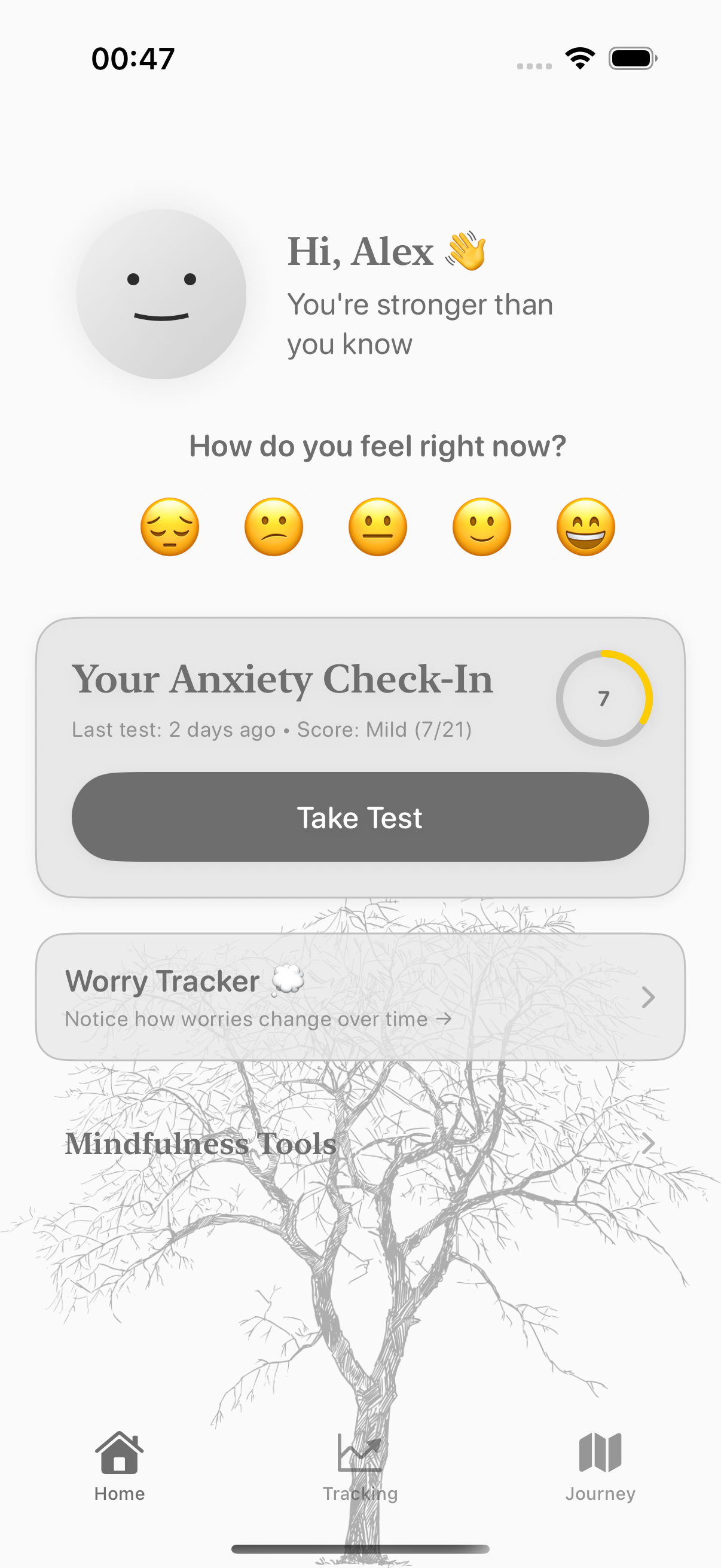
Every check-in is saved and Home shows the latest score with its band. Check-ins are unlimited and free, so you can check in on your anxiety every week and let the weekly reminder keep the habit going.
No account is needed. The app asks for a first name, and your check-ins are kept on your device.
Get a clearer picture of how you feel.
Download on the App StoreNo account required. Start with a free anxiety check-in.
Sources
- 1.phqscreeners.com (Spitzer, Williams, Kroenke and colleagues), “Instruction Manual: Instructions for Patient Health Questionnaire (PHQ) and GAD-7 Measures,” phqscreeners.com
- 2.phqscreeners.com, “GAD-7 (the questionnaire, English),” phqscreeners.com
- 3.PubMed, U.S. National Library of Medicine, “A brief measure for assessing generalized anxiety disorder: the GAD-7,” pubmed.ncbi.nlm.nih.gov
- 4.National Institute of Mental Health, “Generalized Anxiety Disorder: What You Need to Know,” nimh.nih.gov